

Welcome
Welcome to the South East Community Leagues Association (SECLA) website! SECLA is an area council consisting of thirteen Community Leagues in central south east Edmonton ~ Avonmore, Bonnie Doon, Capilano, Cloverdale, Forest/Terrace Heights, Fulton Place, Gold Bar, Holyrood, Idylwylde, Kenilworth, King Edward Park, Ottewell and Strathearn. We are a not for profit organization registered under the Societies Act of Alberta.
As an area council we provide support to our member community leagues and residents thereof, and strengthen community networks by providing a forum for collaboration, discussion and the sharing of information.
Five takeaways from SECLA's municipal roundtable
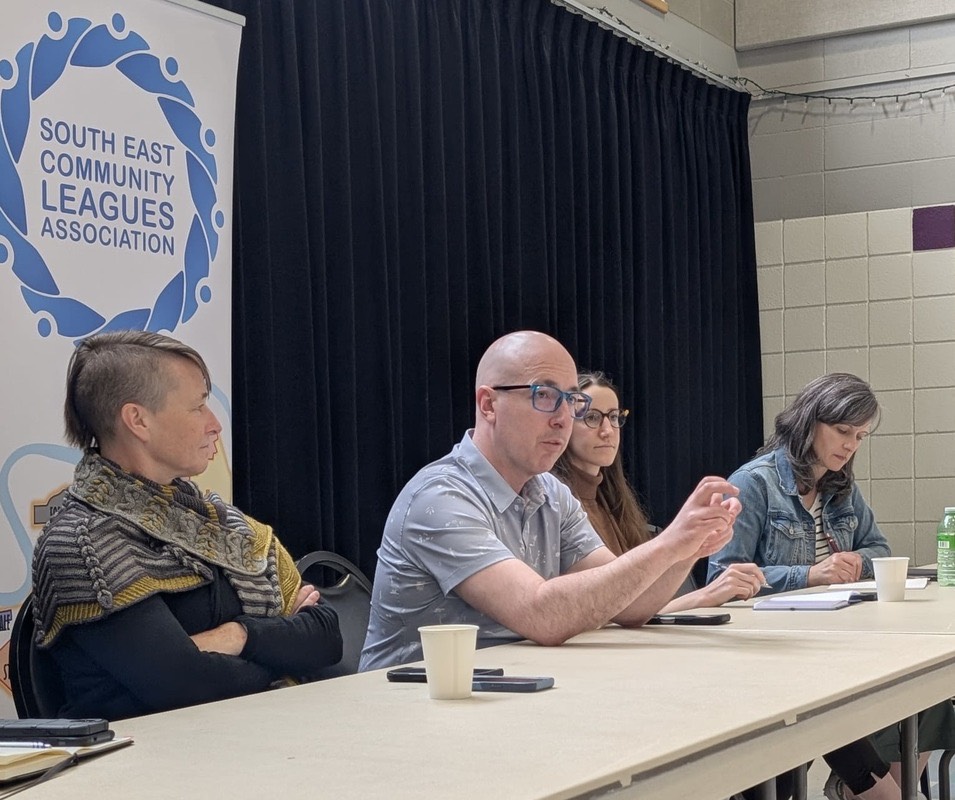
Members of the South East Community Leagues Association (SECLA) met with Mayor Andrew Knack, Ward Métis Councillor Ashley Salvador, Edmonton Public School Board Ward D Trustee Nickela Anderson, and Ward G Trustee Saadiq Sumar at a roundtable event on Sunday, May 3.
League members had a chance to ask questions and voice concerns from their neighbourhoods. Here are five takeaways from the afternoon conversation.
Smaller projects need a new funding solution
From benches to lighting for the Capilano skatepark, leagues have projects that need city support. But there are budget challenges.
“We have $1.37 billion available for our entire four-year capital spend,” Knack told the group. “Whether it’s lighting or benches, anything that is smaller in scale, we don’t do it at all because we don’t have the money to do it. Instead, we can empower communities and work with them and supplement them with, maybe, a grant program for a lot of small-scale infrastructure that leagues can tap into that lets us do a lot of growth projects. I’d rather try that than just do nothing over the next four years.”
League halls need renewal – and have major potential
There are 127 community league halls in the city–with dozens needing renovation. While the city is providing some funding through its Community League Infrastructure Program (CLIP), the Edmonton Federation of Community Leagues (EFCL) is also looking at future ideas like integrating climate resilience.
“EFCL got a grant from Alberta Ecotrust to explore leagues as climate resilience hubs,” said EFCL executive director Laura Cunningham-Shpeley, who was also in attendance. “These are the most important spaces in our neighbourhoods. The U of A did a study about where people would go in an emergency and they said their league. They knew where it was and they knew it would be close by. It’s absolutely something we need to think about. How do we think about smoke days? Hot days? Cold days? These are not just spaces for events.”
As for that CLIP funding? Knack points leagues to the ongoing budget engagement sessions to voice the need for more funding.
Are all roads going to get smaller?
One attendee wondered if neighbourhood renewal equals smaller roads with less parking. Knack’s answer? It depends on where you live.
“We are Edmonton, where 75 per cent of our city drives,” he said. “We certainly want to continue to provide more options for folks, but we also recognize the reality we’re in. The answer is it’s going to depend on every project. We’re doing a lot of arterial road renewal where we don’t shrink the roadways, we just add multi-use trails or something to that existing right of way. I’m sure there’s a mix of opinions, but I can say consistently what I hear when we go into communities is that the collector road in the community is often the high-speed corridor that generates a lot of traffic safety complaints. We know from a traffic safety standpoint, narrowing the road is the best way to keep speeds down–and there is the side benefit of actually costing us less to maintain.”
Renewal is still slated for 101 Avenue
It might be slow, but change will eventually come to the major roadway of 101 Avenue. There are 19 “priority growth areas” earmarked in the city, but 101 Ave. was not in the first round of work.
“I have consistently said that the community support for 101 Ave. should be one of those criteria that pushes it because I know so much work has gone into it,” said Salvador. “There’s huge buy in from the surrounding neighbourhoods. We’ve already done the preliminary design, so we’re at phase two of a five-step process. There are moving pieces I think we can push on, even though we don’t have line-of-sight to the end funding.”
School renewal for mature neighbourhoods a challenge
While new schools are being built for new neighbourhoods, mature neighbourhoods–like those in SECLA’s purview–are home to older schools in need of updating.
Unfortunately, priorities are all about the numbers.
“We monitor the condition of all our buildings and our 10-year facility plan,” Anderson said. “These areas have a lot of older infrastructure that has some deferred maintenance we track and pay attention to. We switched to replacements because the provincial government has a stronger appetite for it. We do track places like Hardisty and Forest Heights and pay attention to the standard.”
Added Sumar: “One hard truth that we may not talk about all the time is that particularly in mature neigbourhoods, we always keep track of student population. I can think of a few examples that I would love to put in a proposal to the province to get a replacement school or brand new school built there, but the challenge is we don’t have the number of students to be able to support a new school there.”